
Blog
Expert Tips for Proper Orchid Species Identification
Sep
Key Takeaways
- Correct orchid species identification helps determine proper care requirements.
- Growth patterns, leaves, roots, and flowers all provide clues for identification.
- Flower structure remains the most accurate method of identifying orchid species.
- Orchid identification by leaves is useful when plants are not blooming.
- Understanding common orchid genera makes identification much easier.
- BB Orchids supplies clearly labeled orchid varieties and expert growing guidance.
Nothing’s more frustrating than inheriting a beautiful orchid or receiving one as a gift, only to watch it struggle under your care because you can’t figure out what species it is. With over 25,000 orchid species and too many hybrids to count, accurate orchid identification might seem impossible, but in reality, most houseplant orchids fall into just a few common categories.
Different varieties of orchids have vastly different care needs than others, and what works for one orchid variety might be damaging to another. That’s why proper orchid species identification is a critical first step for any orchid owner.
Why Orchid Species Identification Matters
Why do we need to know how to identify orchids? Understanding what type of orchid you have informs your approach to care. For example, Phalaenopsis orchids thrive in low light while Vandas demand bright conditions. Some orchids bloom annually, while others can flower multiple times per year. Without proper orchid species identification, you’re essentially guessing at care requirements, and it’s likely not to end well for your orchid.
Different orchid varieties also have overlapping signs of issues that indicate different diseases. Wrinkled leaves on a Cattleya indicate dehydration, but the same symptom on a Phalaenopsis often signals root rot. Knowing how to identify orchid types helps you interpret these signals correctly and make the right choice for care.
Reading Growth Patterns for Clues
Start your orchid species identification by examining how your plant grows. Orchids follow two basic patterns that provide immediate identification clues: Monopodial and Sympodial.
Monopodial orchids – Grow straight up from a central stem, adding new leaves at the top while older leaves remain at the bottom. These orchids typically have thick, leathery leaves and prominent aerial roots. Phalaenopsis and Vanda orchids follow this pattern.
Sympodial orchids – Grow horizontally, producing new vertical shoots from the base. These often feature pseudobulbs – large storage organs that look like bulbs at the base of each growth. Cattleya, Dendrobium, and Oncidium orchids are typical sympodial growers.
Using Blooms for Identification
Flowers provide the most reliable orchid species identification method; however, you’ll need to wait for its blooming season. Here’s what to keep an eye out for.
Flower size – Size matters significantly in determining orchid species. Phalaenopsis flowers are typically 3-4 inches across, while miniature orchids might have blooms under an inch wide. Cattleyas produce some of the largest flowers, often reaching 6 inches or more.
Number of flowers – Count the number of blooming flowers, too. Phalaenopsis usually displays multiple flowers on arching spikes, while Cattleyas often produce just 2-4 large blooms per spike. The arrangement, both color and location, tells a lot about the orchid’s species.
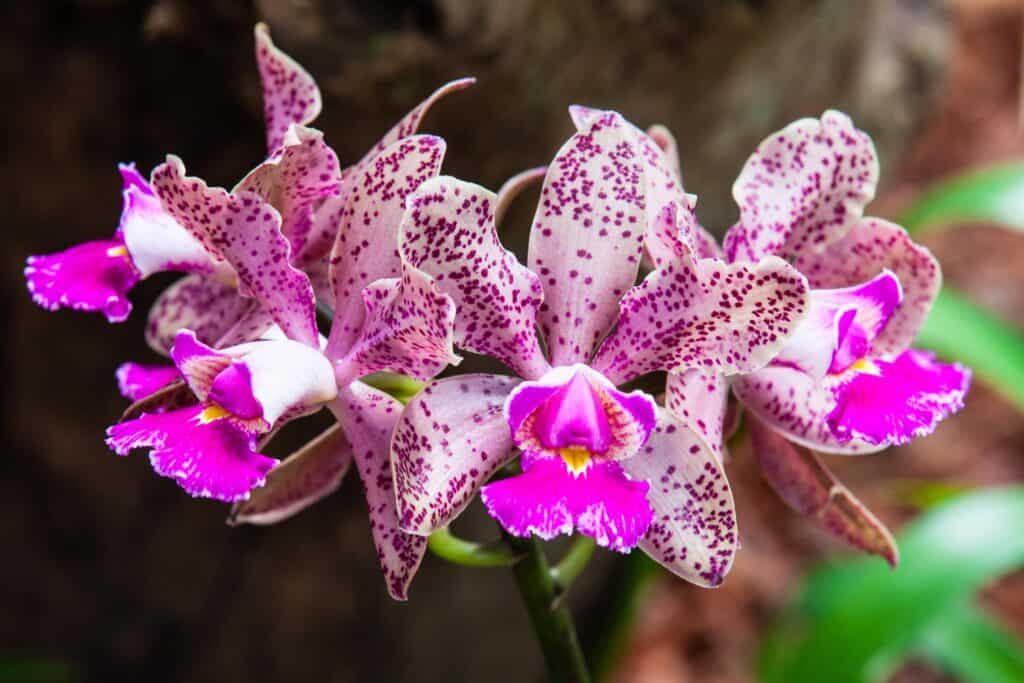
Lib structure – The lip is another specialized part of the flower that makes certain orchids distinctive. Phalaenopsis have simple, broad lips, while Cattleyas feature elaborate, ruffled labellum. Oncidiums often have small flowers with prominent yellow lips, earning them the apt nickname “dancing lady orchids.”
Orchid Identification by Leaves
When flowers are not available for examination, orchid identification by leaves becomes one of the most useful methods for narrowing down a plant’s identity. Leaf characteristics often provide valuable clues about an orchid’s natural growing environment and care requirements.
Thickness of leaves – Orchids with thick, fleshy, or succulent leaves are typically adapted to brighter conditions and can tolerate periods of dryness between waterings. Popular examples include Vanda and Cattleya orchids, both of which store moisture in their leaves and are generally more tolerant of higher light levels.
In contrast, orchids with thinner leaves often prefer more consistent moisture and lower light conditions. These orchids tend to lose water more quickly and may require closer attention to watering and humidity levels. Examples include Miltonia orchids and some Phalaenopsis hybrids, which naturally grow in more shaded environments.
Leaf shape, size, and arrangement – Growers should pay attention to factors such as leaf length, width, texture, and how the leaves are positioned on the plant. For example, Vanda orchids typically produce long, strap-like leaves arranged in neat rows along a central stem, while Phalaenopsis orchids develop broad, fleshy leaves that grow in a distinctive fan-shaped pattern from the plant’s base.

Orchid Identification Guide to Common Varieties
Here are the most common orchid varieties and their signature features:
Phalaenopsis orchids – The photo-perfect standards: thick leaves in a fanned-out pattern, arching flower spikes, and flowers that last months. They’re the easiest to identify and care for.
Dendrobium orchids – Grows tall stalks with flowers emerging along the stems. Some are deciduous, dropping leaves after blooming, while others are evergreen. Their cane structure is unmistakable.
Cattleya orchids – Feature large pseudobulbs with thick, leathery leaves. Their flowers are famously large, plump, and often fragrant. Many have a single leaf per pseudobulb, though some varieties have two.
Oncidium orchids – Produce masses of small flowers, often yellow with brown markings. The delicate flowers have a characteristic “dancing” appearance when they move in air currents.
Vanda orchids – Have thick, strap-like leaves arranged in two rows up a central stem. Their flowers are large, flat, and intensely colored, often in blue and purple hues rarely seen in other orchids.
So, What Type of Orchid Do I Have?
Sometimes orchid species identification requires expert help. Your best bet might be local orchid societies that often have members who can identify unusual varieties from photos. Otherwise, many nurseries and florists employ staff with knowledge about orchid variety identification.
Photography helps when seeking expert advice. Take clear photos of the entire plant, close-ups of leaves and growth pattern, and include any available flowers or old flower spikes.
If your orchid isn’t currently blooming, you might need to wait, especially if it isn’t showing any of the signs of disease. Flowers provide the most definitive identification features, and proper care based on basic growth patterns can keep your plant healthy until it blooms.
Trusted Supplier Support at BB Orchids
At BB Orchids, we understand the importance of orchid species identification as part of proper orchid care. Our Oncidium orchid farm in Thailand produces clearly labeled varieties, eliminating the guesswork for our commercial customers. Whether you’re a retailer needing properly identified stock or a distributor seeking reliable varieties, our expertise ensures you receive orchids with complete identification and care guidance.
Contact BB Orchids today to explore our extensive collection and learn how you can care for your orchids the right way.
Frequently Asked Questions About Orchid Species Identification
Q: How do I identify an orchid species?
A: The best approach combines observations of growth habit, leaf characteristics, roots, and flowers. Flowers provide the most reliable clues for accurate identification.
Q: Can orchid identification by leaves be accurate?
A: Yes. While flowers provide the strongest evidence, orchid identification by leaves can often narrow identification to a specific genus or group.
Q: What is the easiest orchid to identify?
A: Phalaenopsis orchids are among the easiest to identify because of their broad leaves, arching flower spikes, and distinctive flower shape.
Q: Why is orchid species identification important?
A: Proper identification helps growers provide the correct light, water, humidity, and fertilization requirements.
Q: Can I identify an orchid without flowers?
A: Yes. Growth habit, leaf shape, pseudobulbs, and root structure can provide useful clues even when the plant is not blooming.
Q: What are monopodial orchids?
Monopodial orchids grow upward from a single stem and include genera such as Phalaenopsis and Vanda.
Q: What are sympodial orchids?
A: Sympodial orchids grow horizontally and produce new growth from the base. Examples include Cattleya, Dendrobium, and Oncidium.
Q: Where can I get help identifying my orchid?
A: Local orchid societies, experienced nurseries, and orchid specialists can often provide an orchid species identification guide or assistance, especially when clear photos are available.