
Blog
A B2B Guide to Exporting Dendrobium Orchids From Thailand
May
Key Highlights
- Thailand’s Dendrobium orchid exports are regulated by the Plant Quarantine Act and require DOA inspection and a phytosanitary certificate, with CITES rules applying depending on species and propagation method.
- Artificially propagated Dendrobium hybrids—especially tissue-cultured plants—often qualify for CITES exemptions, simplifying international trade.
- Buyers must secure import permits, confirm special declarations, arrange experienced freight forwarding, and prepare for immediate post-delivery care to avoid delays or rejections.
Table of contents
- Thailand’s Orchid Export Framework
- Are Thai Orchids Covered by CITES?
- Required Export Documents
- What Buyers Need to Prepare on Their End
- Import permits
- Special declarations
- Freight forwarder
- Post-delivery care
- How BB Orchids Simplifies the Export Process
- Partner With Thailand’s Leading Dendrobium Orchid Farm
Thailand shipped over $62 million worth of orchids in 2024, and Dendrobiums account for the largest share of that figure. For B2B buyers sourcing from Thai growers, the pricing and variety are hard to beat. But getting those plants across the border means working within a specific regulatory framework, and the paperwork trips up more first-time importers than the plants themselves.
This guide breaks down the export standards for Dendrobium orchids from Thailand, covering the legal framework, every document involved, and what buyers need to prepare. Whether you’re a wholesale nursery in Vietnam, a distributor in India, or a breeding operation in Sri Lanka, knowing these standards upfront saves time and avoids shipment rejections.
Thailand’s Orchid Export Framework
Thailand’s orchid exports are governed by the Plant Quarantine Act B.E. 2507 (1964), amended in 1999 and 2008. The Department of Agriculture (DOA) serves as the country’s National Plant Protection Organization (NPPO) under the International Plant Protection Convention, and they’re the authority responsible for certifying exported plants.
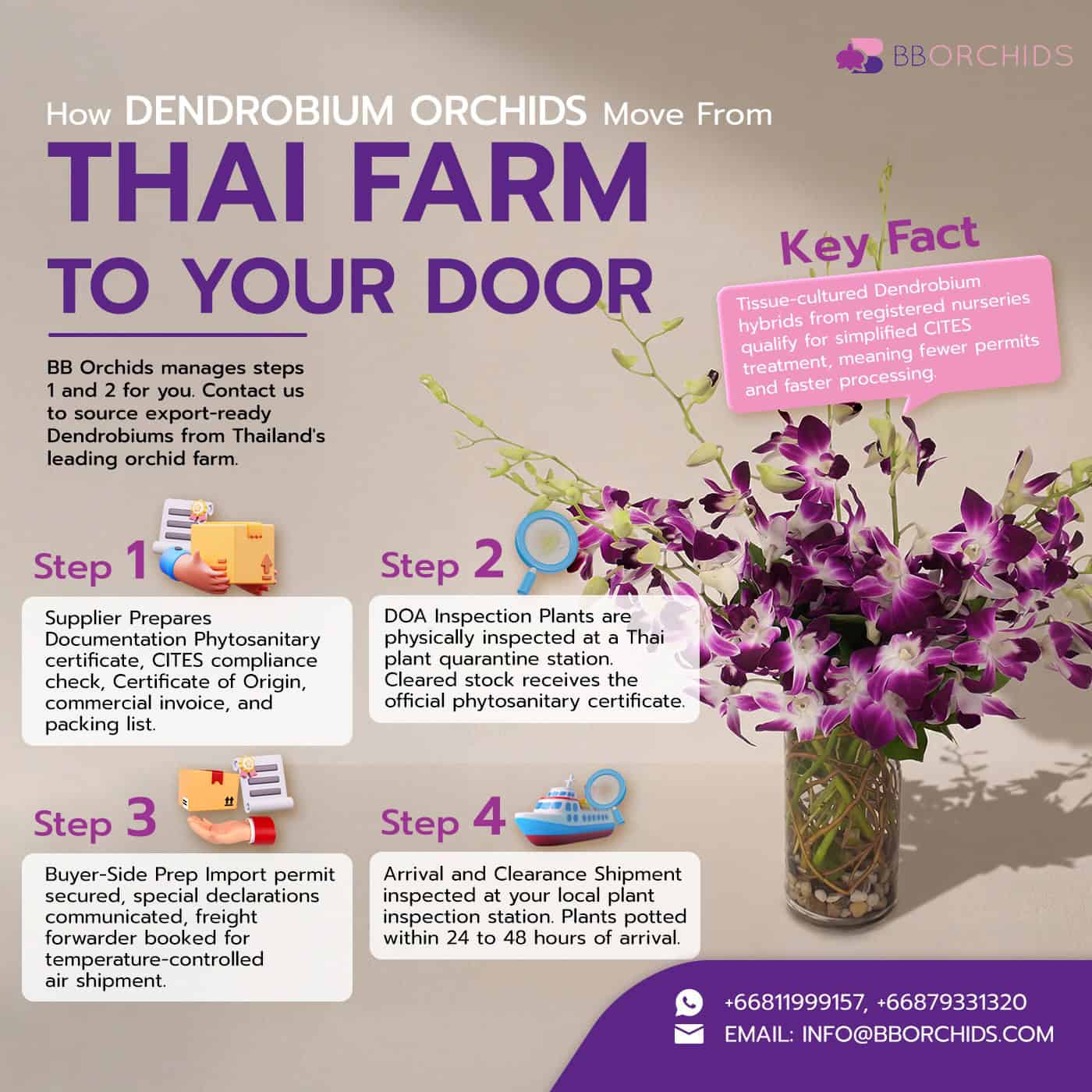
In practice, every shipment of live orchid plants leaving Thailand must pass through a DOA inspection at a plant quarantine station. If the plants are found free from regulated pests, the DOA issues a phytosanitary certificate. No certificate, no export.
For buyers, this framework is a safeguard. The plants arriving at your port have already been government-inspected at the source. Compliance protects both sides: the exporter avoids rejections, and the buyer receives stock that’s been cleared before it left Thailand.
Are Thai Orchids Covered by CITES?
Yes. The entire Orchidaceae family, including Dendrobiums, is listed under CITES Appendix II. Commercial trade is allowed but regulated.
Here’s where it matters: there’s a critical distinction between wild-collected orchids and artificially propagated ones. Wild-collected plants need individual CITES export permits. But commercially propagated orchids from any reputable dendrobium orchid farm are treated differently.
Under the current CITES annotation, artificially propagated hybrids of Dendrobium (along with Phalaenopsis, Cymbidium, and Vanda) can be exempted from CITES permit requirements, provided the specimens are clearly nursery-grown (uniform size, healthy roots, no signs of wild collection) and shipped in batches of 20+ plants of the same hybrid with proper documentation.
Tissue-cultured Dendrobiums get even simpler treatment. Flasked seedlings transported in sterile containers are explicitly exempt from CITES controls. For buyers purchasing at the flask stage, that means fewer permits and faster processing.
Required Export Documents
Here’s the full list for live Dendrobium plant exports from Thailand:
- Phytosanitary Certificate: Issued by Thailand’s DOA after physical inspection. Mandatory for every international shipment. In 2022, Thailand issued these electronically through its ePhyto system.
- CITES Export Permit (when applicable): Required for orchid species (not hybrids) and shipments that don’t meet the artificial propagation exemption. Most commercial Dendrobium hybrid orders from established nurseries won’t need this.
- Certificate of Origin: Issued by Thailand’s Department of Foreign Trade. Comes in two types: a non-preferential certificate for standard trade verification, and a preferential certificate that lets buyers in FTA partner countries claim reduced or zero import tariffs. Thailand has 14 FTAs covering 18 countries, primarily in ASEAN.
- HS Code classification: Live orchid plants fall under HS Code 0602.90.20. Cut orchid flowers use 0603.13.00. Getting this right matters for customs clearance and duty calculation.
- Soil-free and bare root requirements: Most importing countries require orchids shipped without growing media. Plants must be washed with all soil, bark, and moss removed. Dendrobiums handle bare-root transit well thanks to their resilient root systems.
What Buyers Need to Prepare on Their End
The export side is your supplier’s responsibility. But buyers have homework too.
Import permits
Most countries require one for live plants. In the US, orders of 13+ plants need a USDA PPQ-587 permit (free, valid 5 years). India, Vietnam, Sri Lanka, and EU countries each have their own requirements. Apply early, as first-time permits can take weeks.
Special declarations
Some countries require specific certifications on the phytosanitary certificate, like “free from root knot nematodes” or “free from thrips.” Communicate these to your supplier before the plants go for inspection.
Freight forwarder
Live plants are perishable and time-sensitive. Use a forwarder experienced in agricultural goods who understands temperature-controlled transit and plant inspection protocols.
Post-delivery care
Inspect plants immediately upon arrival. Bare-root Dendrobiums should be potted within 24 to 48 hours. Have your media and facilities ready before the shipment lands.

How BB Orchids Simplifies the Export Process
Understanding the export standards for Dendrobium orchids from Thailand is one thing. Finding a supplier who handles the compliance work is another.
BB Orchids, operated under Pramote Orchid Farm (POF), has been cultivating and exporting orchids for nearly three decades. Our farms in Nakhon Pathom and Samut Sakhon are equipped with an in-house tissue culture laboratory established in 2010. Because our Dendrobiums are verifiably tissue-cultured, they meet the conditions for CITES exemption, meaning fewer permits and faster processing for buyers.
Our Dendrobium collection includes 343+ varieties at every growth stage: flask, seedling, blooming, and flowering sizes. We handle export documentation end to end, from coordinating phytosanitary inspection to preparing commercial paperwork and confirming CITES compliance for your order.
Partner With Thailand’s Leading Dendrobium Orchid Farm
BB Orchids is Thailand’s leading dendrobium orchid farm, supplying customers across Asia and around the world. Our farms, Pramote Orchid Farm (POF), in Nakhon Pathom and Samut Sakhon have advanced facilities for mericlone production, seed culturing, and hybrid testing. We specialize in Dendrobiums, Cattleyas, and Phalaenopsis varieties, providing orchids from flask through blooming size.
Trusted by orchid breeders, wholesale nurseries, and businesses worldwide, we pride ourselves on:
- Premium, export-grade orchid plants
- Carefully selected and developed hybrids
- Customized support for small to large orders
- Friendly, responsive customer service
Learn from our orchid care blog for more growing tips and trade insights.
Thai orchid export regulations are well-established, and experienced suppliers handle the documentation. What matters is partnering with a farm that knows the system. BB Orchids is here to back your business with quality varieties and professional support.
Contact us to order and we’ll handle the export documentation so you can focus on growing your business.
References:
Thailand retains the crown as world’s No. 1 orchid exporter. Retrieved February 20, 2026, from https://www.nationthailand.com/news/general/40047643
Thai Flower Exports Flourish worth USD71.3M in 2024. Retrieved February 20, 2026, fromhttps://thailand.prd.go.th/en/content/category/detail/id/2078/iid/372043
CITES Appendices. Retrieved February 20, 2026, from https://cites.org/eng/app/appendices.php
Frequently Asked Questions About Export Standards for Dendrobium Orchids from Thailand
Q: What documents are required to export orchids from Thailand?
A: Every shipment of live orchid plants from Thailand requires a phytosanitary certificate issued by Thailand’s Department of Agriculture (DOA). Depending on the species and shipment size, a CITES export permit may also be needed. Other standard documents include a Certificate of Origin (issued by the Department of Foreign Trade), a commercial invoice, and a packing list. Plants must be shipped bare-root and soil-free to comply with most importing countries’ agricultural regulations.
Q: Are Thai orchids covered by CITES regulations?
A: Yes. All orchids belong to the family Orchidaceae, which is listed under CITES Appendix II. International trade is permitted but regulated. However, artificially propagated hybrids of Dendrobium, Phalaenopsis, Cymbidium, and Vanda can be exempted from individual CITES permit requirements if the plants are clearly nursery-grown, shipped in uniform batches, and accompanied by documentation confirming artificial propagation. Tissue cultures in sterile containers are also exempt.
Q: Do I need an import permit to buy Dendrobium orchids from Thailand?
A: In most countries, yes. The United States requires a USDA PPQ-587 import permit for orders of 13 or more plants (free, valid for 5 years). Countries in the EU, ASEAN, and South Asia have their own permit requirements through their national plant protection organizations. Check with your local agricultural authority before placing your first order.
Q: Can Dendrobium orchids be shipped with soil or growing media?
A: No. Most countries require live orchid plants shipped bare-root, meaning all soil, bark, moss, or other growing media must be completely removed before export. This prevents the introduction of soil-borne pests and pathogens. Dendrobiums handle bare-root shipping well thanks to their resilient root systems. Plan to repot plants within 24 to 48 hours of arrival.