
Blog
How to Get Orchids to Rebloom Successfully
May
Key Takeaway :
- Most orchids stop blooming naturally after flowering — this rest period is normal and not a sign something has gone wrong.
- The most common reasons orchids fail to rebloom are insufficient light, no nighttime temperature drop, and continued high-nitrogen feeding during the rest phase.
- Trimming spent spikes correctly varies by genus: Phalaenopsis spikes can be cut above a node to encourage a second bloom cycle, while Cattleya, Dendrobium, and Vanda spikes should be removed at the base.
- A 10 to 15°F night temperature drop held for four to six weeks is the most reliable trigger for Phalaenopsis spike initiation.
- Starting with healthy, quality-propagated plants from a reputable source significantly improves reblooming success rates.
Table of Content:
- Why Orchids Stop Blooming
- Step-by-Step Guide to Getting Orchids to Rebloom
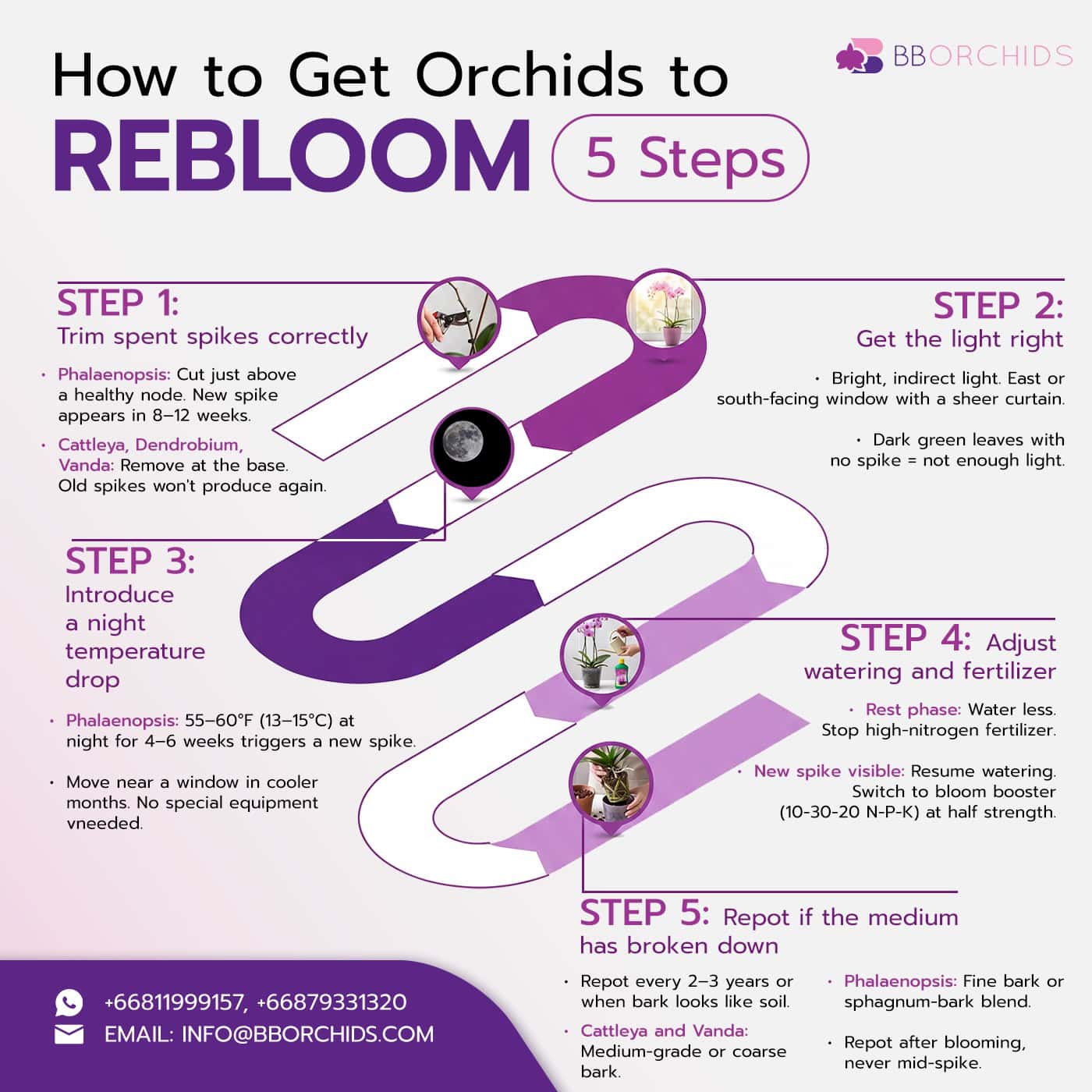
- Step 1: Trim spent spikes correctly
- Step 2: Get the light right
- Step 3: Introduce a night temperature drop
- Step 4: Adjust watering and fertilizer
- Step 5: Repot if the medium has broken down
- Quick Reference by Orchid Type
- Starting With Healthy Plants Makes All the Difference
- FAQs
Many orchid owners experience a similar moment of uncertainty. Weeks have passed since the flowers dropped. The leaves look healthy, yet a new spike is nowhere to be seen. Knowing what an orchid needs to bloom is the key to it flowering annually, rather than just once.
This guide covers the specific conditions that trigger reblooming, the care adjustments that matter by growth stage, and how to handle each major genus differently. If you’re sourcing plants for a nursery or retail operation, there’s also a section on why starting with quality stock changes the whole equation.
Why Orchids Stop Blooming
Orchids bloom seasonally in the wild, triggered by shifts in temperature, light intensity, and rainfall. When those environmental cues are absent, as they often are indoors, the plant stays in vegetative mode. It’s not damaged. It’s just waiting for conditions that tell it flowering time has arrived.
The most common reasons orchids fail to rebloom are:
- Insufficient light. Lush dark-green leaves with no spike after six or more months of post-bloom rest is almost always a light problem.
- No temperature variation. Many orchids, Phalaenopsis in particular, need a meaningful night temperature drop to initiate a new spike.
- High-nitrogen fertilizer during rest. Nitrogen promotes leaf growth. Applying it during the rest phase tells the plant to keep producing foliage, not flowers.
- Root problems. Overwatering and broken-down potting medium lead to root rot, and a plant with compromised roots redirects its energy to survival rather than flowering.
Step-by-Step Guide to Getting Orchids to Rebloom
Step 1: Trim spent spikes correctly
This is where genus matters, and getting it wrong can cost you an entire bloom cycle.
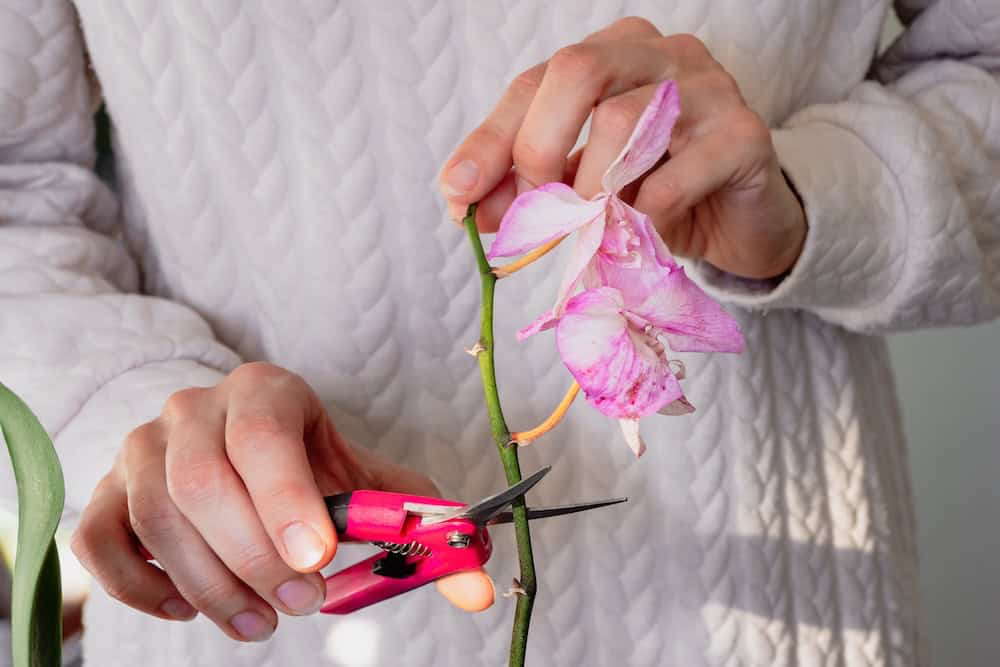
For Phalaenopsis, cut the spent spike just above a healthy node rather than at the base. Nodes are the small bumps spaced along the spike. If you prune slightly above a node, the plant can develop a new shoot from there, typically in about two to three months. If the spike is entirely brown or yellow, cut it off at the bottom.
For Cattleya, Dendrobium, and Vanda, remove spent spikes cleanly at the base. These genera don’t produce secondary blooms from old spikes. Leaving dead material on the plant wastes energy and can invite fungal issues.
Step 2: Get the light right
Bright, indirect light is the baseline requirement for most orchid varieties. A spot two to three feet from a south or east-facing window, filtered through a sheer curtain, works well for most indoor setups. Direct midday sun will scorch leaves. Deep interior light levels will keep plants alive but won’t trigger blooming.
If your orchid’s leaves are very dark green, that’s a sign it’s not getting enough light. Healthy, well-lit orchid foliage is medium green, sometimes with a slight yellowish tint. Increase light gradually to avoid shock.
Step 3: Introduce a night temperature drop
For Phalaenopsis, a night temperature of around 55 to 60°F (13 to 15°C) held consistently for four to six weeks is the most reliable spike trigger. You don’t need special equipment. Moving the plant near a window in autumn, where nighttime temperatures drop naturally, is usually sufficient in most climates.
Other genera respond to similar cues. Dendrobiums benefit from a cool, dry rest period in winter. Cattleyas need a dry rest phase between bloom cycles. Vandas are less temperature-dependent but require consistent high humidity and strong light intensity year-round.
Step 4: Adjust watering and fertilizer
During the rest phase, reduce watering frequency. The potting medium should dry out more fully between waterings than during active growth. Stop high-nitrogen fertilizer completely at this stage.
Once a new spike appears, resume regular watering and switch to a bloom-booster formula: lower nitrogen, higher phosphorus and potassium. A ratio around 10-30-20 (N-P-K) works well as a general guide. Apply at half the recommended label strength to avoid root burn, and water with plain water every third application to flush accumulated salts.
Step 5: Repot if the medium has broken down
Orchid potting media break down over time. Bark becomes fine and compacted, holding moisture for longer than the roots can tolerate. If your plant’s medium looks more like soil than bark chips, or if roots are heavily circling the inside of the pot, it’s time to repot.
For Cattleya and Vanda, use medium-grade bark or a coarser open mix that drains quickly and allows good air circulation around the roots. For Phalaenopsis, fine bark or a sphagnum-bark blend retains slightly more moisture, which suits their thicker root system. Repot in spring after the current bloom cycle, not mid-spike.
Quick Reference by Orchid Type
- Phalaenopsis: Night temperature drop of 10 to 15°F for four to six weeks triggers spike. Expect new blooms in three to four months. Cut spike above a node on a healthy green stem.
- Cattleya: Needs strong, bright light and a dry rest between waterings to initiate blooming. Remove spent pseudobulb sheaths to avoid moisture trapping.
- Vanda: High light, high humidity, and consistent feeding year-round. With the right conditions, Vandas can bloom multiple times per year. Bare-root in a hanging basket is the preferred setup.
- Dendrobium: Cool, dry rest in winter — reduce watering and stop fertilizing from November to February. New growth and blooms typically emerge in spring.
Starting With Healthy Plants Makes All the Difference
Every grower knows the difference between a plant that reblooms reliably and one that sits dormant for eighteen months. Most of that difference comes down to the plant’s starting condition.
Orchids from Thailand have long been preferred by wholesale nurseries and retailers for their genetic quality, disease-free propagation, and consistency across large orders. BB Orchids, operating as Pramote Orchid Farm (POF) across facilities in Nakhon Pathom and Samut Sakhon, propagates all its plants through on-site mericlone and seed culturing. Every plant that leaves the farm arrives with a healthy root system and the growing history to back it up.
Available varieties include Cattleya, Vanda, Dendrobium, Phalaenopsis, Oncidium, Mokara, and more, supplied at flask, seedling, and blooming size depending on your requirements.
BB Orchids is Thailand’s leading orchid farm, supplying customers in Asia and across the globe. Our farms in Nakhon Pathom and Samut Sakhon have the advanced facilities required for mericlone production, seed culturing, and hybrid testing. We specialize in Dendrobiums, Cattleyas, and Phalaenopsis varieties, providing orchids at every level from flask through blooming size.
Trusted by orchid breeders, wholesale nurseries, and businesses worldwide, we pride ourselves on:
- Premium, export-grade orchid plants
- Carefully selected and developed hybrids
- Customized support for small to large orders
- Friendly, responsive customer service
Explore our Orchid Care Blog for more growing tips and trade insights.
How to get orchids to rebloom reliably starts long before the spike appears. It starts with a plant that was propagated properly, grown in the right conditions, and shipped with care. Whether you’re restocking a nursery or sourcing for an event, healthy orchids from Thailand give you the best shot at consistent blooms. Explore BB Orchids’ full collection at bborchids.com or get in touch at info@bborchids.com to request a wholesale catalog.
Reference
- Orchid Growing. Retrieved on April 3, 2026 fromhttps://edis.ifas.ufl.edu/publication/EP325
- Export Certification. Retrieved on April 3, 2026 from https://www.doa.go.th/en/
Frequently Asked Questions About How To Get Orchids To Rebloom
Q: Why won’t my orchid rebloom?
A: The most common reasons are insufficient light, no night temperature variation, and continued high-nitrogen fertilizing during the rest phase. Phalaenopsis orchids in particular need a consistent night temperature drop of 10 to 15°F over four to six weeks to initiate a new flower spike. Check light levels first — very dark-green foliage with no spike after several months almost always points to a light deficiency rather than a fertilizer or watering issue.
Q: How long does it take orchids to rebloom?
A: It depends on the genus and growing conditions. Phalaenopsis typically produce a new spike eight to twelve weeks after the temperature-drop trigger is introduced, with blooms opening three to four months after the rest period begins. Cattleyas and Dendrobiums follow seasonal cycles and generally bloom once per year under normal indoor care. Vandas can bloom multiple times per year with consistent high light and humidity.
Q: Should I cut the orchid spike after flowers fall?
A: For Phalaenopsis, cut the spike just above a healthy green node rather than at the base. This gives the plant the option to produce a secondary bloom from that point. If the spike has turned brown or yellow, remove it at the base. For Cattleya, Dendrobium, and Vanda, remove spent spikes at the base entirely. These genera do not produce secondary blooms from old spike material.
Q: How much light do orchids need to bloom again?
A: Most orchids need bright, indirect light to rebloom. A position two to three feet from an east or south-facing window, filtered through a sheer curtain, works well for Phalaenopsis. Cattleya and Vanda require stronger light intensity — direct morning sun is beneficial for these genera. A reliable indicator of insufficient light is very dark-green foliage with no flowering activity. Healthy, well-lit orchid leaves are medium to light green.