
Blog
Best Orchid Potting Mix for Healthy Roots and Blooms
Apr
Key Highlights :
- Orchids are predominantly epiphytic plants, meaning they grow anchored to trees rather than in soil. Standard potting mix suffocates their roots and causes rot within weeks.
- The best potting mix for orchids combines excellent drainage, strong airflow, and the right moisture retention for the specific genus being grown.
- Orchid bark suits humid growing environments and established plants. Sphagnum moss suits drier conditions and young seedlings. Most growers use a blend of both.
- Potting media should be replaced every one to two years. Decomposed, compacted media that retains too much water is the leading cause of root decline in orchids.
- Professional Thailand orchid exporters use optimized growing media matched to each genus, which directly improves plant resilience during shipping and post-delivery survival rates.
Table of Content:
- What Is the Best Potting Mix for Orchids?
- Common components in a quality orchid mix
- Can You Use Regular Potting Soil for Orchids?
- Orchid Bark vs. Moss: Which Is Better?
- When to use bark
- When to use moss
- When to use both
- How Often Should Orchid Potting Mix Be Changed?
- Signs it’s time to repot
- What Happens If Orchids Are Planted in Soil?
- Why Proper Growing Media Matters for Export Quality
- How Professional Orchid Growers in Thailand Ensure Quality
- Export preparation at the farm level
- Choosing a Reliable Thailand Orchids Exporter
- Partner With BB Orchids for Export-Ready Orchid Supply
- FAQs
The best potting mix for orchids is one that drains fast, allows air to move freely around the roots, and dries out between waterings. Standard components include bark chips, sphagnum moss, perlite, and charcoal. Regular potting soil is unsuitable because it holds excess moisture, depriving orchid roots of air and leading to decay quickly.
Most orchids are epiphytes. In the wild, they grow anchored to tree bark with roots exposed to open air, not buried in dense ground. Any growing medium that mimics those conditions will support healthy orchids. Anything that doesn’t will work against you regardless of how well you water or fertilize.
What Is the Best Potting Mix for Orchids?
Most orchids found in commercial cultivation are epiphytes. In the wild, they grow anchored to tree bark, exposed to open air circulation, with roots that dry out quickly between rain events. Replicating those conditions in a pot is the whole challenge.
The best potting mix for orchids shares three key characteristics: it drains fast, allowing air to move freely through and around the root zone, and it holds just enough moisture to keep roots hydrated without staying wet. Standard garden soil does none of these things adequately.
Common components in a quality orchid mix
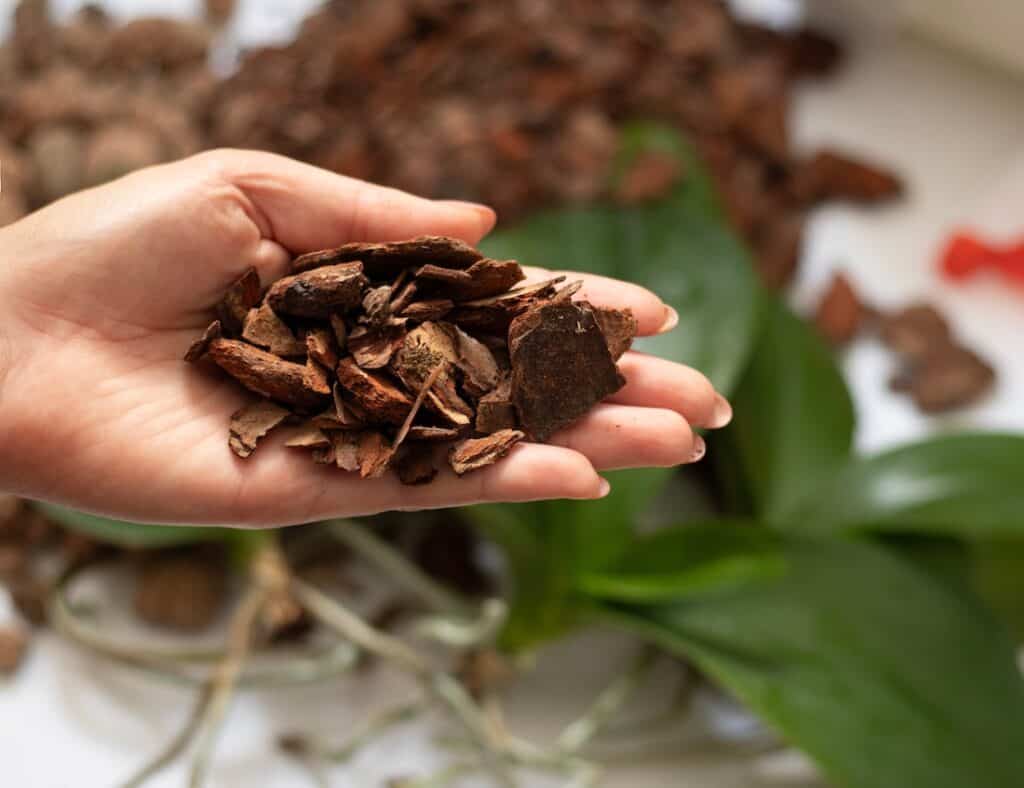
- Bark chips: Fir bark or pine bark in medium or coarse grade. Forms the structural base of most orchid mixes. Breaks down over one to two years and needs replacing when it does.
- Sphagnum moss: Retains more moisture than bark. Used in mixes for seedlings or in dry growing environments where bark alone dries too fast.
- Perlite: Improves drainage and prevents compaction. Useful in bark mixes for growers in high-humidity environments.
- Horticultural charcoal: Keeps the mix fresh by absorbing waste products and reducing bacterial buildup. Used in smaller proportions as a supporting component.
The right combination depends on the genus, the local climate, and whether the plant is a seedling or a mature specimen.
Can You Use Regular Potting Soil for Orchids?
The short answer is no. Regular potting soil is formulated for terrestrial plants with root systems that tolerate or even prefer sustained moisture. Orchid roots are built for the opposite condition.
Standard soil retains water around the root zone for extended periods. In an orchid pot, that sustained moisture cuts off oxygen from the roots, creates the conditions for fungal and bacterial rot, and typically kills the plant within weeks. The roots turn brown, go soft, and lose the ability to take up water or nutrients regardless of how carefully you water.
Leaf symptoms typically indicate a root issue, even if wilting seems to be the primary concern. By then, the damage is generally permanent.
This distinction is most important for commercial orchid buyers. Plants in poor soil are already damaged by the time they reach the consumer.
Orchid Bark vs. Moss: Which Is Better?
Neither is universally better. The right choice depends on your growing environment and the specific orchid you’re working with.
| Orchid Bark | Sphagnum Moss | |
| Drainage | Excellent | Moderate |
| Airflow | High | Lower |
| Moisture retention | Low to moderate | High |
| Best for | Humid climates, mature plants | Dry environments, seedlings |
| Breakdown rate | 1 to 2 years | 1 to 2 years |
| Risk if overused | Dries too fast in low humidity | Stays too wet in high humidity |
When to use bark
Bark is the better base for most established orchids, particularly in tropical or subtropical growing environments where ambient humidity is already high. Vandas, Cattleyas, and Dendrobiums do well in bark-dominant mixes with good airflow. In high-humidity farms like those in Thailand’s central plains, medium-grade bark drains fast enough to prevent waterlogging between watering cycles.
When to use moss
Sphagnum moss suits seedlings and young plants that need slightly more consistent moisture around their developing root systems. It’s also a practical choice in drier indoor growing environments where bark-based mixes lose moisture too quickly. Moss presents a risk of compaction as time progresses. When it degrades and compacts, it retains excessive moisture and requires swift replacement.
When to use both
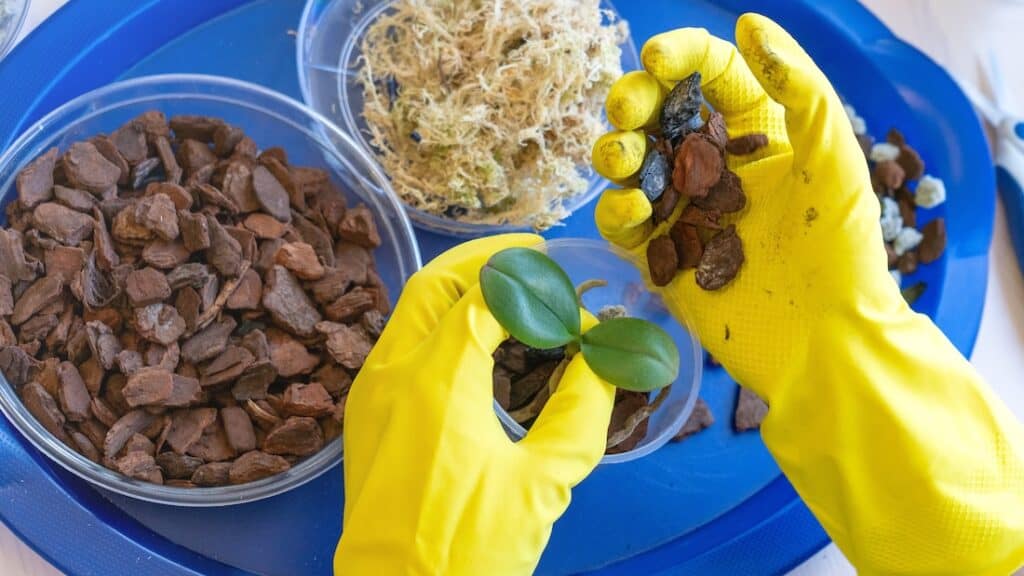
Many professional growers use a layered or blended approach: bark as the primary structural component with a proportion of moss and perlite adjusted to local conditions. At BB Orchids, growing media is matched to each genus rather than applied as a single standard mix across all varieties.
How Often Should Orchid Potting Mix Be Changed?
The general guideline is every one to two years, but the condition of the media matters more than the calendar. Bark and moss break down with time and repeated watering. As they decompose, the particle size decreases, the mix compacts, and it starts behaving more like regular soil than a free-draining orchid substrate.
Signs it’s time to repot
- The medium looks dark, fine-grained, and compacted rather than chunky and open.
- Water sits on the surface rather than draining through immediately.
- Roots are circling heavily inside the pot or pushing out through drainage holes.
- The plant’s leaves are yellowing or wrinkling despite regular watering, which points to root dysfunction caused by poor media.
Repot in spring after the current bloom cycle ends. Avoid repotting mid-spike because the plant redirects energy away from flowering when disturbed.
What Happens If Orchids Are Planted in Soil?
Root suffocation happens first. Orchid roots require oxygen as much as they require water, and dense soil cuts off that oxygen supply within days of planting. The roots begin to rot from the outside in.
Fungal and bacterial pathogens move in quickly once root tissue starts breaking down. In warm, moist conditions, this process accelerates. The plant’s ability to take up water collapses, and the leaves begin to wilt and yellow despite the soil being wet.
Commercial operations face repercussions due to the immediate plant loss. Plants from poor media conditions are stressed and often fail after delivery, leading to more customer complaints, returns, and damage to the buyer’s reputation. The initial growing medium for a plant after propagation establishes its foundation for future development.
Why Proper Growing Media Matters for Export Quality
For a Thailand orchids exporter shipping to buyers across Asia, Europe, and the Americas, growing media is not just a horticultural decision. It’s a logistics decision.
Plants with strong, well-developed root systems built in appropriate media handle shipping stress significantly better than plants grown in substandard conditions. Transit by air freight, even when managed well, involves temperature variation, pressure changes, and periods without water. A plant with healthy roots arrives in viable condition. A plant with compromised roots often doesn’t.
Consistent growing media standards also mean predictable plant performance on arrival. Wholesale buyers and nurseries depend on that consistency to manage their own operations. If post-delivery survival rates vary unpredictably, the supply relationship becomes unreliable regardless of how competitive the pricing is.
How Professional Orchid Growers in Thailand Ensure Quality
Thailand’s orchid farming industry has developed over decades, and the farms that export successfully to international markets share several consistent practices.
Growing environments are controlled to maintain stable temperature, humidity, and light conditions matched to each genus. Media selection is specific to variety, not generic across the whole operation. Phalaenopsis growing in fine bark with moisture-retaining additives sits in a different house from Vandas in coarse bark with open-air root exposure.
Export preparation at the farm level
Before shipment, plants are assessed individually for root health, foliage condition, and growth stage. Roots are cleaned and prepared according to the destination country’s phytosanitary requirements. Bare-root preparation removes all growing media before packing, which reduces shipment weight, satisfies import regulations in most markets, and allows the receiving buyer to repot into their preferred substrate on arrival.
At BB Orchids, this process runs through our facilities in Nakhon Pathom and Samut Sakhon. Plants are propagated through on-site mericlone and seed culturing, which means the genetic and health baseline is established before a plant ever goes into a pot.
Choosing a Reliable Thailand Orchids Exporter
Not every farm that sells orchids operates at export standard. For B2B buyers building a consistent supply chain, these are the factors that separate a reliable long-term partner from a one-time supplier.
- Cultivation expertise by genus. A farm that grows its own stock and adjusts media, environment, and care by variety produces more consistent plants than one applying a single approach across all species.
- Transparent quality standards. Ask how the farm grades plants before shipment and what the process is when a delivery falls short of specification.
- Export documentation capability. Phytosanitary certificates, CITES documentation, and bare-root preparation should be handled in-house. Outsourcing documentation introduces delays and errors.
- Logistics and communication. A good exporter coordinates freight timing, communicates on transit updates, and is reachable when something needs resolving. Response time before the sale is a reliable indicator of support quality after it.
Partner With BB Orchids for Export-Ready Orchid Supply
BB Orchids is Thailand’s leading orchid farm, supplying customers in Asia and across the globe. Our farms, Pramote Orchid Farm (POF), in Nakhon Pathom and Samut Sakhon have the advanced facilities required for mericlone production, seed culturing, and hybrid testing. We specialize in Dendrobiums, Cattleyas, and Phalaenopsis varieties, providing orchids at every level from flask through blooming size.
Trusted by orchid breeders, wholesale nurseries, and businesses worldwide, we pride ourselves on:
- Premium, export-grade orchid plants
- Carefully selected and developed hybrids
- Customized support for small to large orders
- Friendly, responsive customer service
Explore our Orchid Care Blog for more growing tips and trade insights.
Choosing the best potting mix for orchids is one part of the equation. The other part is sourcing from a grower who gets it right before the plant ever reaches you. Plants that arrive with healthy roots, grown in appropriate media, and prepared to export standard give your operation the best possible starting point. Whether you’re a wholesale nursery, a florist supplier, or a commercial grower, that consistency is what makes a supply relationship worth maintaining.
Partner with a trusted Thailand orchids exporter to receive high-quality, export-ready orchids cultivated with the right growing media and care standards. Contact us at info@bborchids.com to request a wholesale catalog or get a quote within three business days.
Reference
- Repotting and Growing Media. Retrieved on April 3, 2026 from https://www.aos.org/orchids/culture-sheets.aspx
- Royal Horticultural Society — Orchid Growing Guide. Retrieved on April 3, 2026 from https://www.rhs.org.uk/plants/types/orchids/growing-guide
Frequently Asked Questions About The Best Potting Mix For Orchids
Q: What is the best potting mix for orchids?
A: The best potting mix for orchids drains fast, allows strong airflow around the roots, and holds just enough moisture without staying wet. Most quality mixes use medium or coarse bark chips as the base, combined with varying proportions of sphagnum moss, perlite, and horticultural charcoal depending on the genus and local growing conditions. Standard potting soil is not suitable for orchids under any circumstances.
Q: Can I use regular potting soil for orchids?
A: No. Regular potting soil is formulated to retain moisture over extended periods, which is the opposite of what orchid roots need. Planting orchids in standard soil cuts off oxygen to the roots, creates conditions for fungal and bacterial rot, and typically kills the plant within weeks. The damage is usually irreversible by the time symptoms appear on the leaves.
Q: Is orchid bark better than moss?
A: It depends on the growing environment and the orchid genus. Bark provides better airflow and faster drainage, making it the preferred base for mature plants in humid climates. Sphagnum moss retains more moisture and suits seedlings or drier growing conditions. Most professional growers use a blend of both, adjusted to the specific variety and local humidity levels.
Q: How often should orchid soil be changed?
A: Orchid potting media should be replaced every one to two years, or sooner if the medium has broken down and become compacted. Signs that it’s time to repot include poor drainage, darkened and fine-grained media, roots circling heavily inside the pot, and leaves wilting despite regular watering. Repot after the current bloom cycle ends, not mid-spike.
Q: What happens if orchids are planted in soil?
A: Planting orchids in regular soil leads to root suffocation and rot. Dense soil blocks oxygen from reaching the roots, which begins breaking down root tissue within days. Fungal and bacterial pathogens accelerate the decline once roots start deteriorating. The plant loses its ability to take up water, leaves wilt and yellow, and in most cases the plant cannot be saved once significant root loss has occurred.