
Blog
How to Choose Fresh Dendrobium Orchids: A Buyer’s Guide
Sep
Key Takeaways
- How do buyers choose fresh dendrobium orchids? Check for firm green stems, clean, unblemished petals, and a mix of open blooms plus unopened buds.
- Buy directly from reliable growers who follow proper harvest timing, cold chain management, and consistent grading to ensure quality.
- Extend vase life by recutting stems, changing water regularly, and keeping orchids away from heat, direct sunlight, and ripening fruit.
Dendrobium orchids represent one of the most extensively traded cut flowers globally. The freshness of these items depends on three factors: when harvesters cut them, how handlers manage them, and how the cold chain maintains temperature. The stem can last for as long as two weeks if all three components are in ideal condition. However, if the situation becomes unstable, your orchids could shed their blooms by the fourth day. Here’s how to choose fresh Dendrobium orchids, whether you’re purchasing in person or ordering a batch online.
Why Freshness Matters When Buying Dendrobium Orchids
For buyers who depend on quality cut flowers for their businesses or events, freshness is important due to the following reasons:
Longer vase life
Cut orchids already outlast most other cut flowers. A fresh Dendrobium can hold for about two weeks with good handling. A stem cut too early or kept warm drops florets within days.
Better appearance and color retention
Fresh, well-handled blooms keep their color and shape. Petals stay smooth and evenly colored instead of browning or turning translucent. That look is what drives display-led sales.
Stronger stems for floral arrangements
A fresh stem is firm and upright, so it’s easier to work with. Designers can cut, wire, and position it without bending or snapping. Soft, dehydrated stems are harder to handle and fail sooner.
Greater value for florists and event professionals
Freshness protects both margin and reputation. Fresh stems survive conditioning, transport, and the event itself, while early-fading stock means remaking arrangements or letting a client down on the day.
What a Fresh Dendrobium Stem Looks Like
Here’s what to look for when determining the freshness of your Dendrobium shipment:
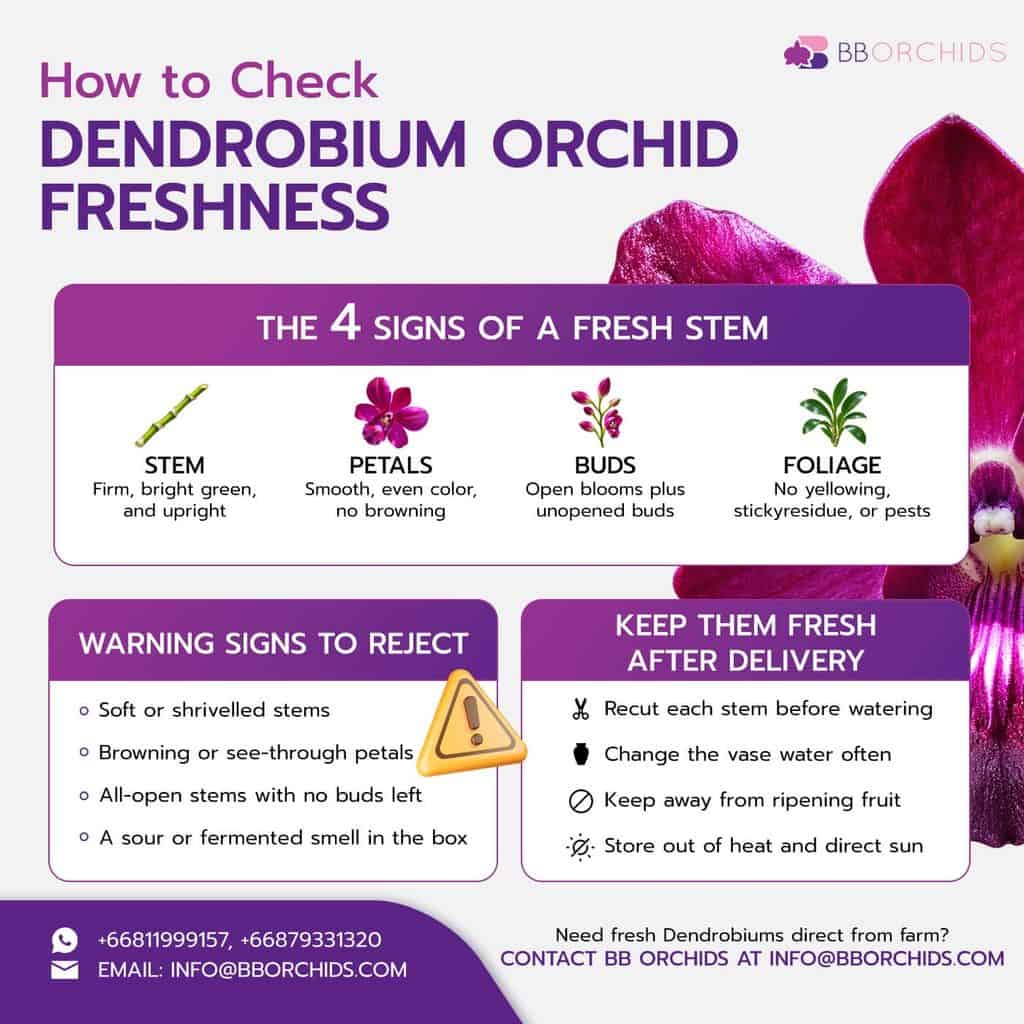
- Stem condition: Firm, bright green, upright. Soft patches, shrivelling near the cut end, or a limp look all mean the stem is tired or dried out.
- Petal surface: Smooth and evenly colored. Browning at the edges, see-through patches, or bruising from packing will only spread, not heal.
- Bud ratio: A good stem has open flowers plus unopened buds further up. All-open stems have less life left, even if they look showier on arrival.
- Foliage and spike: No yellowing, sticky residue, or pest damage. Sticky residue usually means scale or mealybug somewhere in the batch.
Extra tip: smell the box. A sour or fermented note means moisture got trapped and bacteria have started to grow.
How to Buy Fresh Dendrobium Orchids? Check for Quality
These are some of the criteria for good-quality Dendrobiums:
- Uniform flower size: Big variation within one grade points to loose sorting at the farm.
- Even bloom spacing: Gaps along the spray mean designers need more stems to fill the same space.
- Repeatability across deliveries: The grade you get in March should match the grade you get in September. This is where tissue-cultured stock and in-house propagation pay off.
- Post-harvest discipline: Ask if cutting tools are sterilized between plants. Virus can pass from plant to plant during harvest, so disposable blades or sterilized tools are the standard fix.
Questions You Should Ask Your Supplier
Ask these questions when putting in your inquiry to ensure the best quality:
- When are stems cut before dispatch? The standard is three to four days after the flowers open. Stems cut earlier will not open properly once removed from the plant.
- What is the cold chain? Tropical Dendrobiums are chilling-sensitive and need tight temperature control, typically around 10 to 13°C (50 to 55°F), to avoid cold damage. A reliable supplier can state their exact storage and transit temperatures.
- How are stems packed? Confirm carton type, cushioning, and whether stems receive any hydration in transit.
- Do they grow or resell? A grower controls harvest timing. A reseller supplies whatever the farm cut that day.
- What happens if a variety runs short? A supplier who substitutes without asking will do so again during your busiest period.
How to Manage Dendrobium Shipments After They Arrive
Even good stock can be spoiled in the first hour after arrival if placed under the wrong conditions. Here are some things to do to extend the life of your cut Dendobriums:
- Recut on arrival: Give each stem a clean, angled cut before it goes into water.
- Change the water often: Bacteria building up in the vase water is one of the known reasons orchids fade early.
- Keep fruit away: Dendrobium flowers react to ethylene, and a bowl of ripening fruit in the same cold room is enough to speed up floret drop.
- Keep stems out of heat and direct sun: Both cause the flowers to lose water faster than the stem can draw it back up, which leads to wilting.
Sourcing Dendrobiums From BB Orchids
Thailand is the world’s largest orchid exporter. Between 2023 and 2024, the country exported 5.43 billion baht worth of orchids, according to the Department of Business Development. This is due to:
- Year-round production: Because the climate allows continuous growing, a buyer sourcing Dendrobium orchids in Thailand is not planning around a harvest window. This allows for convenient forward orders.
- Established export infrastructure: The trade has built up freight routes, familiar packing standards, and phytosanitary paperwork that farms manage on a weekly basis.
*Import rules still differ by destination. Permits, inspection, and documentation are not the same across the US, the EU, and individual Asian markets, so confirm current requirements with your own plant protection authority before a first shipment.
BB Orchids is a specialist orchid grower in Thailand with facilities in Nakhon Pathom and Samut Sakorn. Dendrobiums and Cattleyas are our main focus. Here, we develop and select our own hybrids to offer the best variety to our buyers and partners, no matter where they are in the world.
Our facilities perform mericlone and seed culturing internally, ensuring consistent flower quality across all batches. Plants are available at all stages of their growth, including in flasks, as seedlings, and when they are blooming or flowering size.
At BB Orchids, we offer:
- Carefully selected hybrids: Only hybrids that meet strict criteria go into production.
- Stage flexibility: Nurseries growing plants on and retailers wanting market-ready stock can each order what fits their timeline.
- Customized orders: We build each order around what you need..
Get in touch with BB Orchids to talk through available Dendrobium varieties, growth stages, and export paperwork for your market. Browse the Dendrobium range, take a look at our Orchid Care Blog for more sourcing tips, or email the team at info@bborchids.com.
References:
- Orchids. Retrieved July 24, 2026, from https://postharvest.ucdavis.edu/produce-facts-sheets/orchids
- Peppermint essential oil enhances the vase life of Dendrobium orchids. Retrieved July 24, 2026, from https://pmc.ncbi.nlm.nih.gov/articles/PMC11153112/
- Thailand retains crown as world’s No 1 orchid exporter. Retrieved July 24, 2026, from https://www.nationthailand.com/news/general/40047643
- Postharvest Technology of Cut Flowers of Orchids. Retrieved July 24, 2026, from https://link.springer.com/chapter/10.1007/978-981-32-9456-1_5
- Exploring the orchid family tree. Retrieved July 24, 2026, from https://www.kew.org/read-and-watch/orchid-family-tree
Frequently Asked Questions About Choosing Fresh Dendrobium Orchids (FAQs)
Q: How do you choose fresh Dendrobium orchids and what quality indicators should you look for?
A: Check the stem before the flowers. Look for firm, bright green stems with no soft spots; smooth, unblemished petals with even color, and a mix of open blooms plus unopened buds further along the spray. Yellowing leaves, sticky residue, or bruised petals indicate age, pests, or rough handling.
Q: How do you buy fresh orchids online, and what should you look for?
A: Ask the supplier when stems are cut relative to dispatch, what storage temperature is used, how cartons are packed, and whether they grow or resell them. Request recent photographs of the actual batch rather than catalog images, and confirm what happens if a variety is unavailable.
Q: How long do fresh Dendrobium orchids last?
A: Vase life varies by cultivar, harvest stage, and handling. Cut orchids are noted for exceptional longevity compared with other cut flowers. Recutting stems on arrival, changing vase water regularly, and keeping stems away from ripening fruit all extend display life.
Q: Why are Dendrobium orchids from Thai suppliers so popular?
A: Thailand is the world’s largest orchid exporter, with orchids accounting for more than half of the 9.32 billion baht in decorative plant exports recorded across 2023 and 2024. The tropical climate supports continuous production, so supply does not depend on a seasonal harvest window.
Q: How should fresh orchids be stored after delivery?
A: Tropical Thai Dendrobiums are chilling-sensitive and need tight temperature control, typically around 10 to 13°C (50 to 55°F), to avoid cold damage. A reliable supplier can state their exact storage and transit temperatures. Keep stems out of direct sun and heat, and store them away from ripening fruit because Dendrobium flowers are ethylene-sensitive.