
Blog
Importing Thai Orchid Seedlings vs Blooming Plants
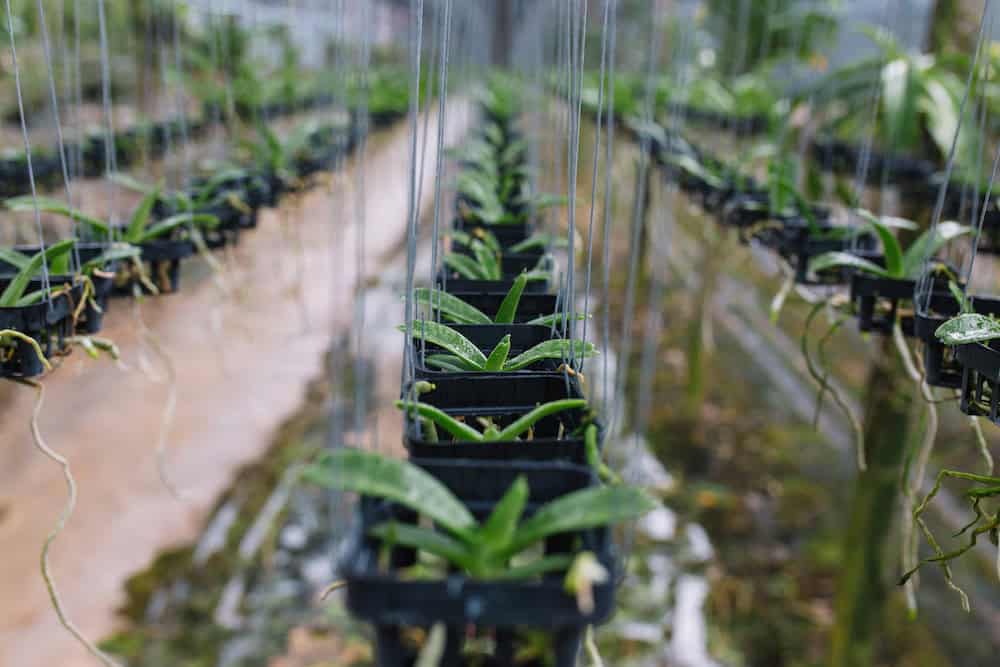
Sep
Key Takeaways
- Seedlings carry the lowest per-unit price and pack up to 1,000 bare-root plants per export carton, but need 12 to 18 months of local grow-out before they hit market value.
- Blooming-size stock is retail-ready on arrival and turns cash within weeks, though larger cartons hold only around 180 to 200 bare-root plants and freight costs more per unit.
- Landed cost tells a different story than unit price once you add grow-out labor, water, fertilizer, and bench space over a 12 to 18 month cultivation window.
- Finishing nurseries with greenhouse capacity favor seedlings for margin capture, while retail florists and event distributors need blooming-size stock for immediate turnover.
- What’s different between Thai orchid seedlings vs blooming plants comes down to your business model, cash flow position, and how fast your buyers need finished plants.
- Combining a Thailand wholesale orchid seedling order with blooming-size stock in one shipment balances immediate sales against future crop cycles.
This guide compares Thai orchid seedlings vs blooming plants side by side, covering unit cost, freight density, time to bloom, and the practical trade-offs so you can match the right stage to your business model. B2B orchid purchasers encounter a common dilemma: either import young seedlings to cultivate them locally, or import fully grown plants that are ready to bloom. This is a critical inventory choice for commercial growers and importers, impacting their cash flow, greenhouse space, and retail sales timing for the subsequent year to eighteen months. If you misjudge the timing, you’ll end up with produce that won’t sell for a year or pay high shipping costs for items you could have grown locally.
Seedlings or Blooming Plants: Business Model Fit
The difference between Thai orchid seedlings vs blooming plants starts with your operation, not the plant. If you run a finishing nursery with bench space and a trained grow-out team, seedlings give you the margin. If you supply florists, event work, or garden centers that need color on the shelf next week, blooming-size stock is the only realistic option.
- For commercial growers and finishing nurseries. Seedlings suit businesses with greenhouse capacity that prefer to grow stock locally and capture the full margin between import cost and blooming-size retail value.
- For retailers, event distributors, and florists. Blooming-size or flowering-size plants suit operations that need immediate turnover, market-ready stock, and predictable delivery windows tied to holidays or events.
Time to bloom is the other side of the equation. Seedlings typically need 12 to 18 months of nursery cultivation to reach maturity, while blooming-size stock is ready to flower once conditions are right. Taking this gap into account is crucial for whether your business model wins or loses money.
Cost and Freight Math for B2B Importers
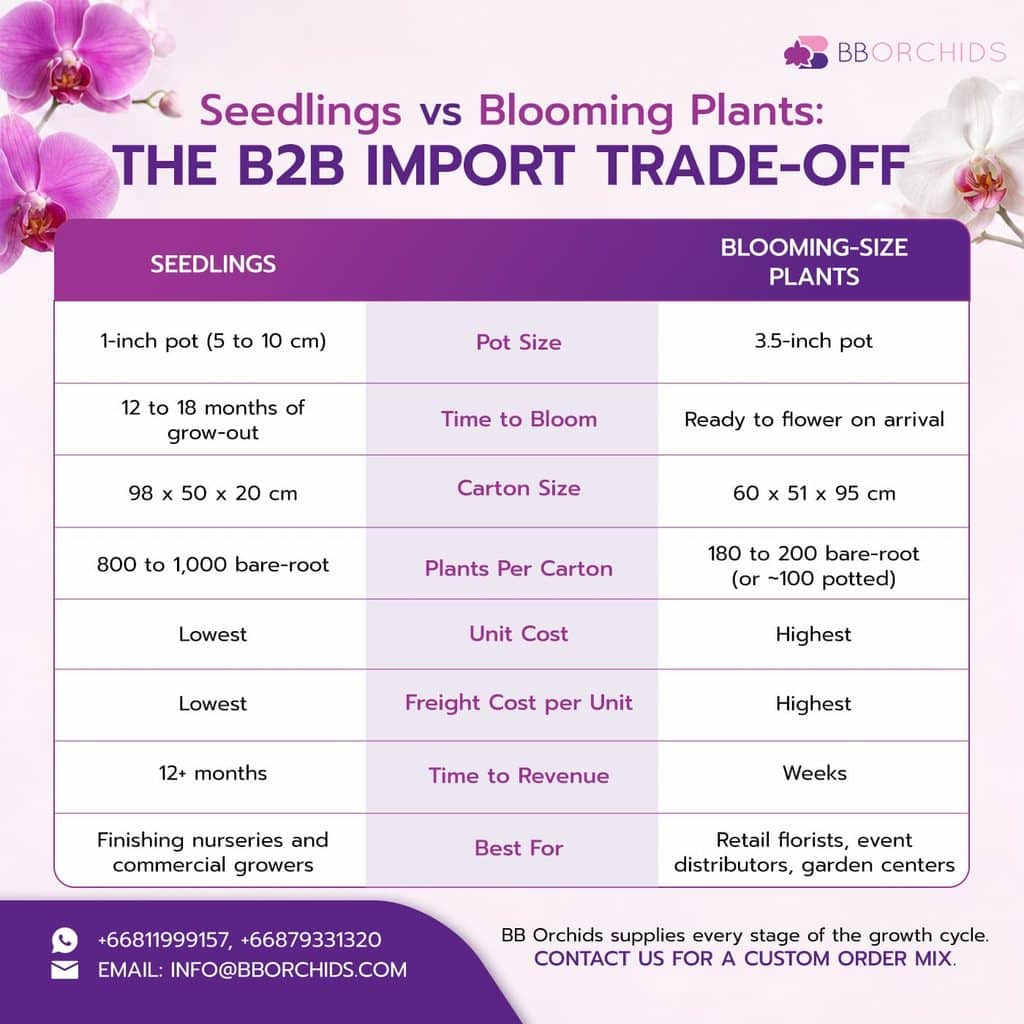
Unit price is the number most buyers look at first, but it’s only part of the picture. A Thailand wholesale orchid seedling in a 1-inch pot (5 to 10 cm) carries a significantly lower price point per plant than a mature 3.5-inch blooming-size plant. The gap gets bigger when freight is also considered.
- Seedlings. A standard export carton measuring 98 by 50 by 20 cm can hold roughly 800 to 1,000 bare-root seedlings. Per-unit freight drops to a fraction of what larger plants cost to ship.
- Blooming-size plants. A larger export carton at 60 by 51 by 95 cm holds around 180 to 200 bare-root blooming-size plants, or roughly 100 potted plants. Freight per unit is materially higher.
Landed cost is where the real comparison lives for Thai orchid seedlings vs blooming plants. Lower import fees on seedlings have to be weighed against the labor, water, fertilizer, media, and bench space you’ll spend during grow-out. Some importers find seedlings win on total cost even after grow-out, particularly when their greenhouse overhead is already covered by other crops. Some growers find that flowering plants are more profitable when they account for cultivation losses and the delay before they start earning money.
The financial considerations shift rapidly when greenhouse space is limited or when customers are unwilling to wait for a year. Calculate your operational costs before ordering a large shipment.
Pros and Cons of Importing Orchid Seedlings
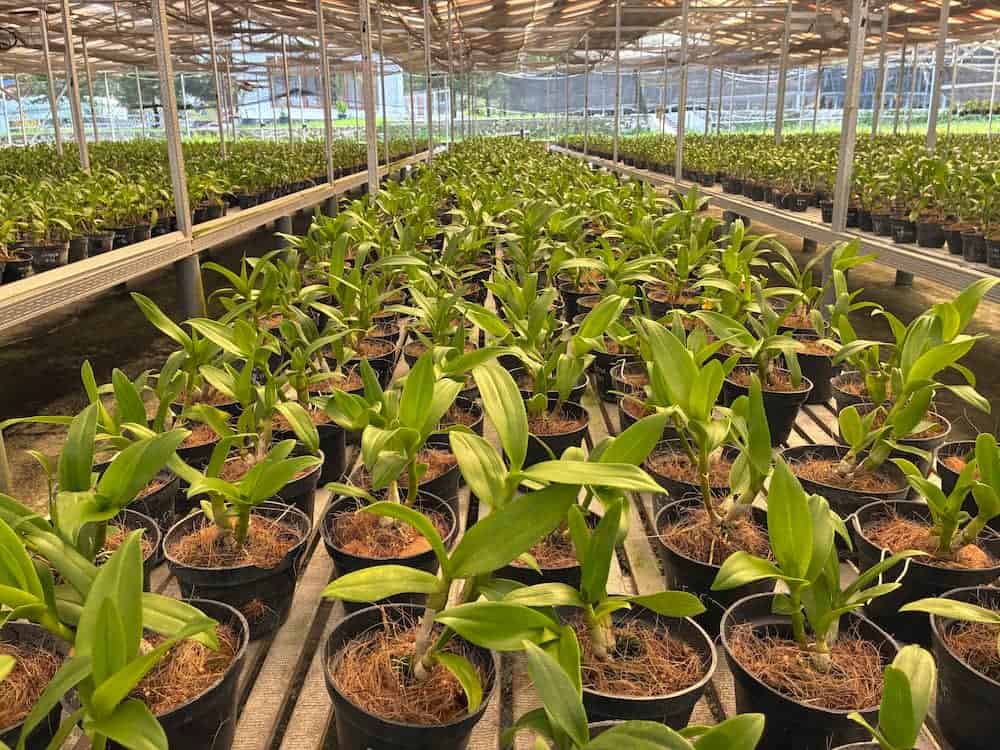
Seedlings aren’t a shortcut, but rather a different business model with a different risk profile. Here’s what to weigh before you commit greenhouse space to a grow-out program.
The upsides
- Lower capital outlay. Substantially reduced unit prices plus lower freight costs per plant.
- High-volume freight. You can bring in thousands of plants in a single shipment, which is hard to match with mature stock.
- Acclimatization. Younger plants tend to adapt more readily to new greenhouse conditions, humidity, and light regimes than mature stock that’s already set in its habits.
The trade-offs
- Delayed revenue. Expect a year or more of care and inputs before the crop is ready to sell at market value.
- Resource demands. Ongoing nursery labor, bench space, watering, feeding, and pest management add up over 12 to 18 months.
- Cultivation risk. Losses during grow-out can eat into the margin if temperature, humidity, or airflow drift outside range. Also, batch losses hurt more when you’ve been carrying the plants for a year.
On the other hand, blooming-size plants flip the trade-off by having a higher landed cost per unit, but revenue can start within weeks of arrival. Neither option is universally better. The ideal choice hinges on your greenhouse size, financial liquidity, growing proficiency, and the urgency with which your customers require ready-to-sell plants.
When purchasing for the first time and exploring a new supplier, it’s generally safer to start with plants that are already blooming-size. This allows you to build trust with the supplier and confirm their shipping and quality standards before incorporating smaller seedlings.
Choose Flexible Wholesale Sourcing With BB Orchids
At BB Orchids, we operate as Pramote Orchid Farm (POF) with facilities in Nakhon Pathom and Samut Sakhon to supply orchids at every stage of the growth cycle. That means tissue-culture flasks, 1-inch seedlings, 3.5-inch blooming-size plants, and flowering stock, all propagated on-site through mericlone and seed culturing. For B2B buyers, the practical benefit is a custom order mix.
Instead of choosing between Thai orchid seedlings vs blooming plants, wholesale buyers can combine both in a single shipment. Blooming-size stock for immediate retail sales, plus seedlings to plant into your grow-out program for next year’s crop. It balances short-term cash flow against long-term margin.
Our export department manages the preparation of bare-root plants, secures them in protective cartons, and obtains phytosanitary certificates from the Thai Department of Agriculture. The buyer is responsible for obtaining destination import permits and species-specific documentation, but we will assist you with the requirements for your market, regardless of whether you are shipping to Vietnam, India, Sri Lanka, or other international locations. Purchasing from Thailand for the first time? A test order allows you to verify the condition of the plants, the quality of the packaging, and how they hold up during shipping before you increase your order size.
Reach out to us at BB Orchids for a Thailand wholesale orchid seedling catalog or email info@bborchids.com to discuss your growth-stage mix. We can provide a tailored FOB quote based on your preferred plant stages, volume, and destination market.
References:
- Plant and Plant Product Imports. Retrieved July 31, 2026, from https://www.aphis.usda.gov/plant-imports
- Plant Quarantine Services. Retrieved July 31, 2026, from https://www.doa.go.th/en/
Frequently Asked Questions About Thai Orchid Seedlings vs Blooming Plants
Q: Should I buy orchid seedlings or blooming plants from Thailand?
A: It depends on your business model. Seedlings suit finishing nurseries and commercial growers with the greenhouse capacity to grow out stock over 12 to 18 months and capture the full margin. Blooming plants suit retail florists, event distributors, and garden centers that need market-ready stock for immediate turnover. Many B2B buyers combine both stages in a single shipment to balance short-term sales with future crop cycles.
Q: Are orchid seedlings cheaper to import than blooming plants?
A: Yes, on unit cost and freight. A 1-inch seedling carries a substantially lower price than a 3.5-inch blooming-size plant, and a standard export carton holds 800 to 1,000 bare-root seedlings compared with 180 to 200 bare-root blooming plants. Landed cost is a different question. Once you add 12 to 18 months of grow-out labor, water, fertilizer, and bench space, the total cost can narrow. Run the numbers for your specific operation before deciding.
Q: What are the pros and cons of importing orchid seedlings?
A: The pros are lower unit and freight costs, high shipment volumes, and better acclimatization to new greenhouse conditions. The cons are delayed revenue of a year or more, ongoing cultivation labor and inputs, and the risk of losses during grow-out if nursery conditions fluctuate. Seedlings work well for growers with greenhouse capacity and cash flow to carry stock for 12 to 18 months.
Q: Can I mix seedlings and blooming plants in one shipment from Thailand?
A: Yes. BB Orchids supplies orchids at every stage of the growth cycle from the same nursery, so wholesale buyers can combine tissue-culture flasks, 1-inch seedlings, and 3.5-inch blooming-size plants in a single order. This is a common way to balance immediate retail sales with grow-out stock for next year’s crop.